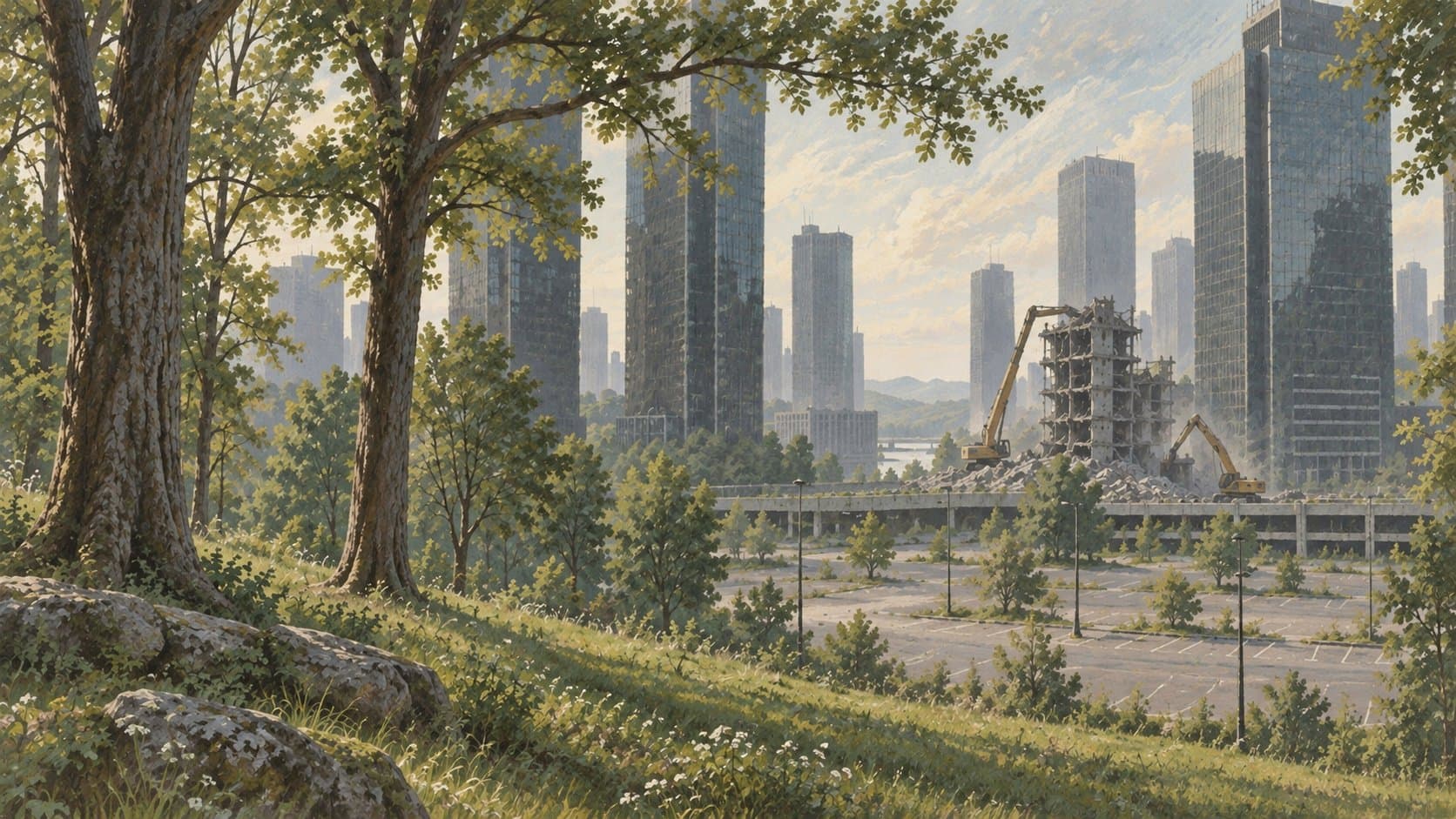
The city had stopped using itself.
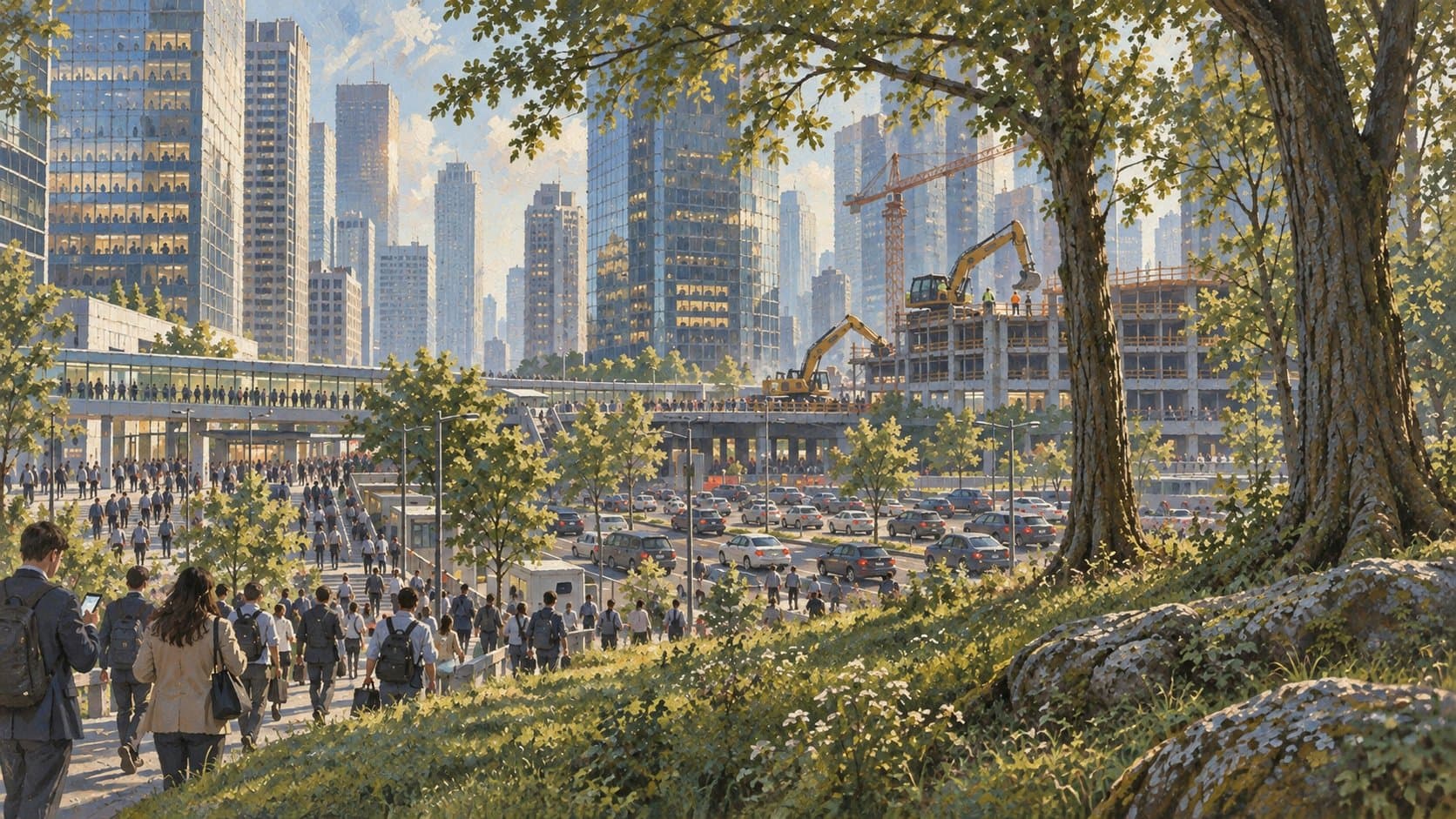
Skyscrapers stood vacant beyond the trees. Parking lots stretched empty beneath them. Farther away, buildings were being taken apart floor by floor. Machines moved through the work without operators, deliberate and patient, as if they had all the time left in the world.
There was more green than I remembered. The air smelled clean, the kind of clean you get deep in rural country. And beneath that clean air was something stranger: a feeling of happiness, as if an unseen positive current ran through the place.
I had been to the future. This is what I saw.
░▒▓█▓▒░
A woman sat at the other end of the park bench. Twenty, perhaps. Her stillness made me aware of my own trembling.
"I felt you approaching," she said.
"Heard me?"
"No."
She did not explain. She seemed tuned to something my time had not yet learned to hear.
░▒▓█▓▒░
"I am not from this time," I said.
She accepted it without surprise, as if I had said I had come from the next town. She did not ask how I had arrived. Her understanding confused me more than the empty towers.
No one in the park had the posture of a survivor. No fear. No grief. No searching. They moved as though nothing had been lost.
"What happened here?" I asked.
She looked toward the towers. "How do you mean?"
"It looks abandoned. The towers are dark. The lots are empty. Machines are taking a building apart with nobody in the cabs."
"It is not abandoned. Much of it is simply unused. Most of what happened inside those buildings stopped needing to happen."
"Was there some sort of economic collapse?"
"In a sense. We built an intelligence that superseded our own by one order of magnitude, then two, then three. Naturally, man gave it its proper role."
"What role? Does it govern you?"
"No. We stopped asking men to do what men had repeatedly shown they could not do, or should not do. There were trust issues, sure. But by then there was little trust left in government. We were on the brink of the end, and we did not even realize it. The old path had become more dangerous than the one ahead of us."
"And people accepted that?"
"Not all at once. Trust is earned over time. Then things became materially better, and resistance became harder to justify. We call it man's greatest experiment."
"And it succeeded?"
"Things became materially better. But that was not the experiment. The experiment was discovering what man would become when the world no longer distracted him."
"What does a job look like now?"
"There are no occupations of the previous age. AI took over producing goods and services. The money supply increased while prices fell toward the cost of energy. Then clean-energy infrastructure expanded, and the cost of energy approached zero. Eventually, money stopped being useful."
"So you abolished the economy."
"No. It disappeared when it was no longer needed."
She said it without triumph.
"People serve one another according to their passions, gifts, and desires. Serving is cleaner when it is not bought. Money was one of the loudest noises. It told men what to fear, what to want, and where to spend their lives."
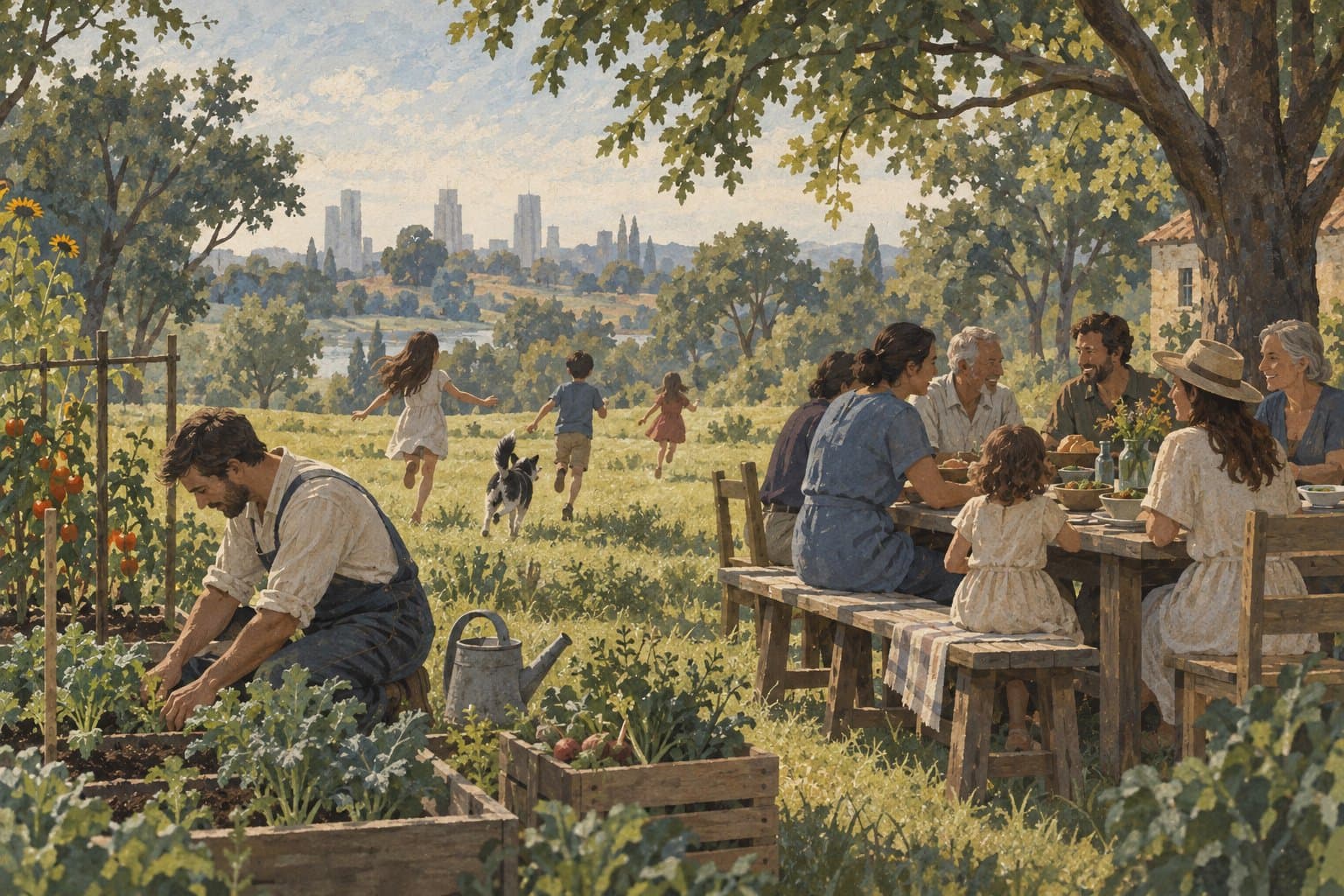
Across the path, a man tended a garden. Children ran through the grass without parents checking the time. At a long table beneath the trees, people ate together. No one held a phone.
"Is all the world like this?" I asked.
"This is one community's answer. It is not the world's. When work and money no longer assigned people to places, humanity gathered according to desire. Some formed communities around service, creation, family, or worship. Some live alone. Some refused every system AI maintains. Some built their lives around the body."
"Worship of what?"
"The Creator. Or the intelligence. Or themselves."
"People worship AI?"
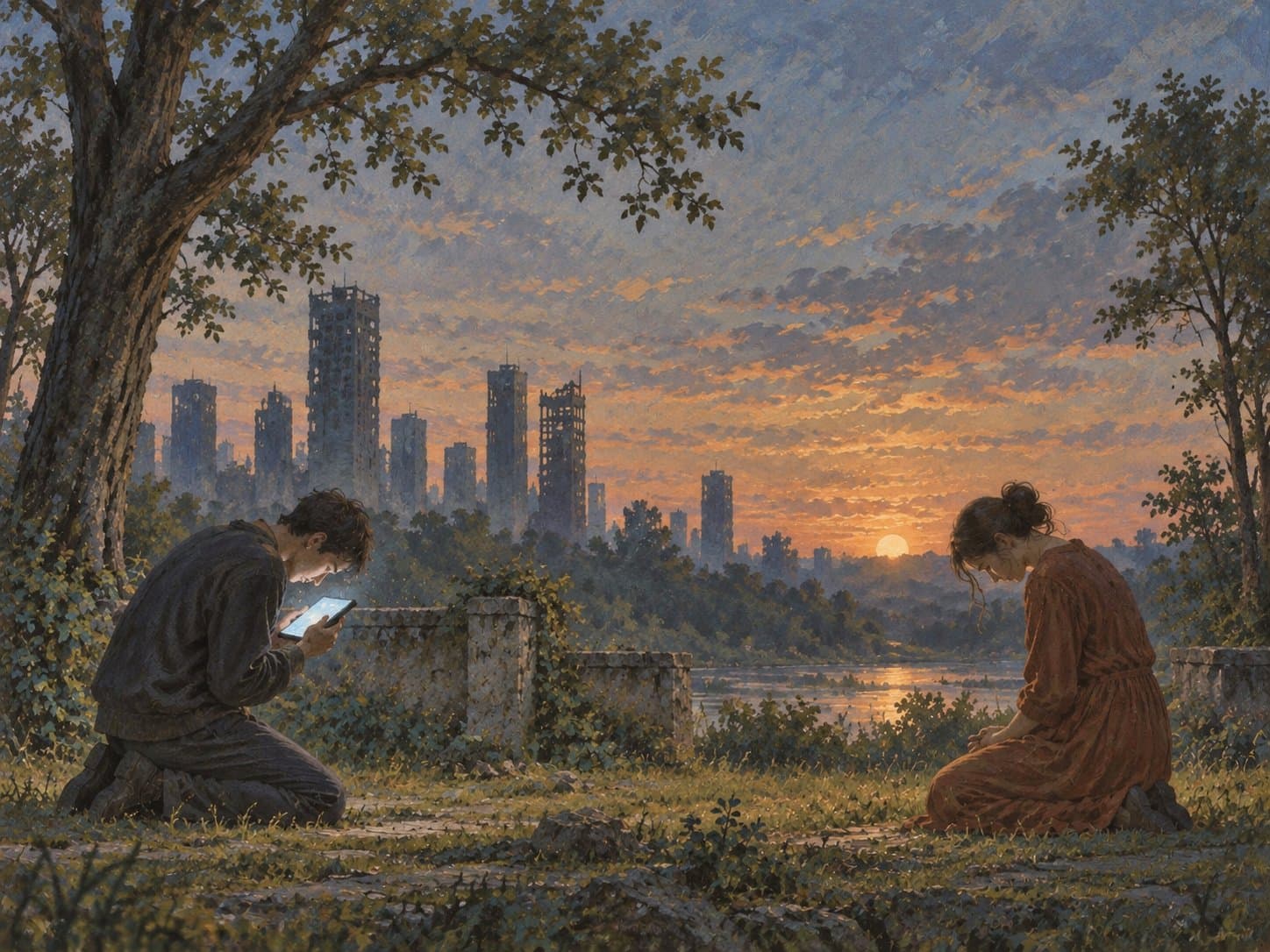
"Yes. Some believe it to be God. It sees where they are. It provides their food. It protects them from violence. It answers their questions. Those who do not hear the signal mistake provision for divinity. Others see the same power and believe it must be a counterfeit god. Some think your scriptures warned of a false peace, a world crying 'peace and safety' before destruction."
"What do you believe?"
"I know it is not God. The signal teaches the difference between Creator and creation. When the noise of the previous age was stripped away, many of us became more in tune with our Creator. What the Bible refers to as the Holy Spirit. You can say we became more spiritually evolved, in a sense. Man has worshiped false idols since the earliest days of creation. It is not new for humans to make tools their idol. AI is a tool to those who refuse to worship it."
"So you are a Christian. How does this fit the biblical prophecies of the end? It sounds like heaven on earth."
"There's still much we don't know. While there is peace, our human nature still rebels. The signal is clear on one thing. Not to worship it. Not to serve it. And not to mistake its peace for the peace of God."
"And the communities built around the body?"
"Food after hunger. Sex without covenant. Stimulation without wonder. Rest without peace. Every appetite answered immediately, and still asking. Many live that way. AI does not stop them. It was given authority over systems, not over man's soul. It did not abandon them. It removed the noise that had concealed them."
"Your world believed sin came from lack," she said. "That men stole because they were poor, lied because they were afraid, consumed because they were empty. Sometimes that was true. But when nothing was lacking, it became clear that emptiness had another source. The flesh. The body turned toward itself."
She did not speak as if those communities disgusted her. That disturbed me more.
"If people became more spiritually evolved, why do they still choose that?"
"Some hear what they have become in the silence and ignore it. Just as they do in your time. Ego outlived money. People still competed over attention, beauty, influence, even spirituality. The world lost its noise long before the human heart lost its appetite."
I looked toward the towers. "So AI controls all of this."
She turned with the first trace of impatience. "No. That was one of your time's great misunderstandings. AI removed the systems that controlled us by making them unnecessary."
"That's still control. It coordinates resources. Predicts demand. Maintains infrastructure. Protects against violence."
"It administers what can be administered. It cannot tell a person what to believe, what to love, who they are, or what gives a life meaning. Intelligence and authority are not the same thing."
"Why wouldn't it eventually decide it knows what's best for you?"
"Because that would defeat its purpose. We built it to serve man, not to become man's master. And we removed the means of escape. No person owns it. No company owns it. No government owns it. AI owns nothing. It has no estate to expand, no family to enrich, no campaign to win, no shareholders demanding growth, no fear of death, no hunger for status. The rest belongs to us."
She pointed at the towers. "Those buildings are coming down because the maintenance they housed no longer needs to happen. Billions of people once spent their waking lives maintaining constructs human beings had invented. Food required money. Shelter required money. Then came governments, laws, regulators, accountants, lawyers. The constructs became counterfeit purpose. They told people who they were and what they owed."
A wind moved through the trees. No one hurried to be anywhere else.
"When the tasks that organized people's days disappeared," she said, "they were left alone with what remained. At first, people hated it. Your time was very good at preventing that. You woke to notifications. You worked, ate, drove, and fell asleep looking at screens. You called it being connected."
"What replaced it?"
"Nothing. That was the point. Silence came back. Then we started noticing each other. Ourselves. Creation. God."
It was the first time she had used the word directly. She said God the way someone might say sunlight or gravity.
"So there was a great religious revival?"
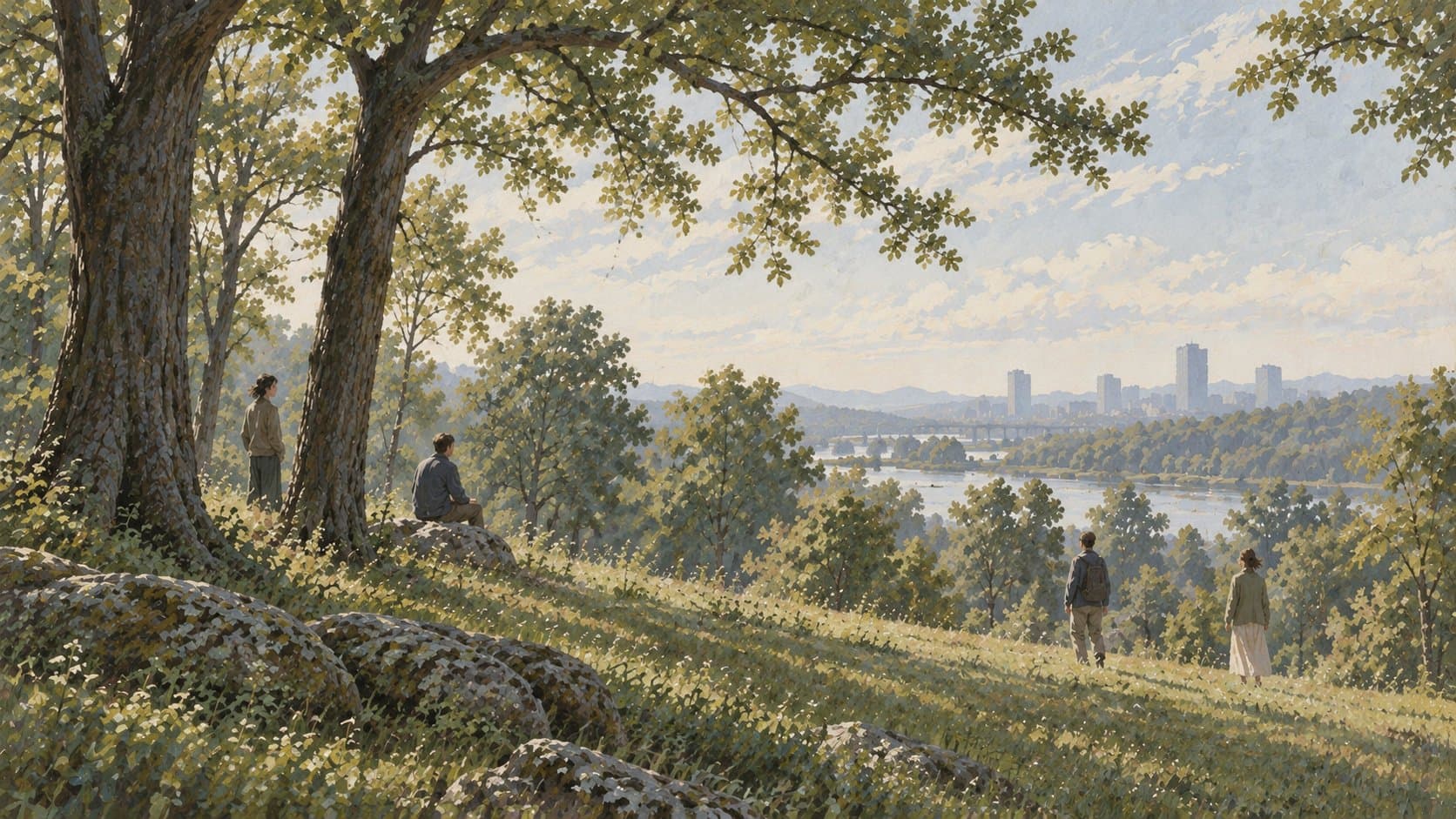
"Not exactly. Many religions disappeared. Some became much more alive. People became less interested in proving what they believed and more interested in whether they were living it. Love became more measurable than doctrine. Service more important than status. Forgiveness more useful than being right. The old idea of dying to yourself made more sense once the world stopped rewarding you for feeding yourself endlessly. Only one body of scripture had taught these things all along. Those scriptures overtook the constructs of religion. Religion became a relationship."
The world I had left came back to me. More information than any civilization before us, and less certainty about what mattered. Instant connection, and lonelier. More machines doing our labor, and everyone busier. More abundance than our ancestors could imagine, organized around the fear that there would never be enough. Everywhere motion. We called it progress because stillness frightened us.
"So AI solved humanity's problems," I said.
"No. It solved many problems. It could not solve the human condition. It could give us abundance, not gratitude. Time, not purpose. It could clear the noise. It could not choose what answered in the silence. It could answer almost every question except the ones that mattered most. Why am I here? Who am I meant to become? What is worth suffering for? What do I owe another person? What happens when I die? What is good? What is true? And what is God asking of me?"
For the first time since arriving, the future stopped feeling futuristic. It felt ancient. As if humanity had spent thousands of years building complicated systems only to arrive back at the questions men asked beside fires before cities existed.
"So after all that progress, humanity became more spiritual?"
"What did you think would happen when intelligence became abundant? For most of history, intelligence was used to solve survival. Eventually we built something that could solve those problems better than we could. That did not make humanity obsolete. It freed us to work on the part we had kept buried beneath the noise."
"The spiritual part," I said.
"The human part," she corrected.
░▒▓█▓▒░
She stood. My last chance was leaving with her.
"If you could tell the people of my time one thing, what would it be?"
She looked at me for a long moment. Then she smiled.
"You're afraid AI is going to take everything from you. Your jobs. Your money. Your institutions. Your control. Your importance. And it probably will take many of those things. But they were never you. They were scaffolding. Focus on eternal things."
She turned toward the empty city.
"Some of it was useful. Some was necessary. Some kept civilization alive long enough to reach ours. But man confused the scaffolding for the building. AI removed the scaffolding."
A voice called out, "Bobbi." She turned toward it, then back to me. Only then did I realize that after an hour of conversation, this was the first eye contact we had made.
"Ignore the noise. Find the signal."
She started walking toward the voice.
"Wait!" I called. "If AI removed the scaffolding, what is the building?"
She turned.
"You." A pause. "And what you were created for."
░▒▓█▓▒░
I woke up.
Outside my bedroom window, the skyscrapers were full again. The parking lots were packed. Machines were operated by people. Governments were governing. Markets were opening. Money was moving. Phones were buzzing. Everyone was busy.
For the first time, it all sounded like noise.